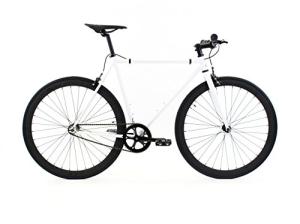
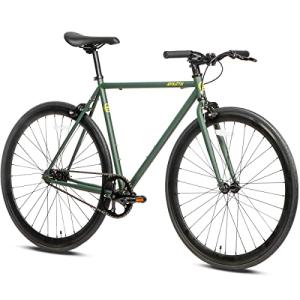
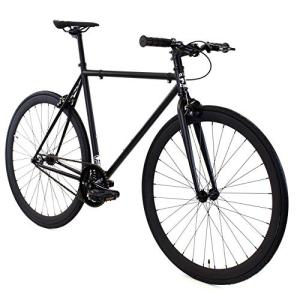
How a Fixed Gear Bike Actually Works
The core mechanical difference comes down to one component: the rear hub. On a standard bike, the hub contains a ratcheting freewheel that lets you stop pedaling and roll freely. A fixed gear hub has no such mechanism. The cog is threaded directly onto the hub, creating a rigid connection between your legs and the rear wheel.
The practical result? You are always pedaling when you're moving. Slow your legs, the bike slows. Resist the pedal motion, you brake. Speed your cadence up, you accelerate. The bike becomes an extension of your body in a way that geared bikes simply cannot replicate.
Most fixed gear bikes sold today come with a flip-flop hub — a double-sided rear hub with a fixed cog on one side and a freewheel on the other. Flip the wheel around and you've got a standard single-speed setup. It's a great feature for beginners who want the option to coast while they build confidence before committing fully to the fixed experience.
Fixed Gear vs. Single Speed: What's the Difference?
People use these terms interchangeably all the time, and that causes a lot of confusion. They're related but not the same thing.
A single-speed bike has one gear but still has a freewheel, meaning you can stop pedaling and coast. A fixed gear bike has one gear and no freewheel at all. All fixed gear bikes are technically single-speed, but not all single-speed bikes are fixed gear.
The riding experience is fundamentally different. On a single-speed, you still have the mental separation between you and the bike that comes from coasting. On a fixed gear, that separation disappears. The bike feels alive under you in a way that's hard to describe until you've experienced it. Many riders who try both find they prefer fixed gear precisely because of that constant physical feedback.
Why People Actually Ride Fixed Gear Bikes
Simplicity That You Can Feel
Strip away the derailleur, the cassette, the shift levers, the cables, the pulleys. What you're left with is a drivetrain that has almost nothing to go wrong. Fewer moving parts means fewer things to adjust, replace, or repair. A fixed gear chain runs in a perfectly straight line from chainring to rear cog, which makes it last considerably longer than the chain on a geared bike that flexes across multiple sprockets.
For commuters, this is genuinely life-changing. You don't need to budget time every few weeks for a derailleur tune-up. You don't need to worry about a cable fraying at the worst possible moment. You check your chain tension, keep it lubed, and get on with it.
Weight Savings That Matter
All those components you're removing add up to real weight. Without a derailleur system, cassette, extra brake hardware, and associated cables, a fixed gear bike is typically noticeably lighter than an equivalent geared bike. For urban riding — carrying the bike up stairs, locking it to a rack, throwing it over your shoulder on the way into the office — lighter is genuinely better.
Building Real Cycling Fitness
Riding fixed forces you to pedal constantly. There's no freewheeling down a gentle slope to catch your breath. Your legs are always working, which means your cardiovascular system is always working too. Many road cyclists use a fixed gear as a winter training bike specifically for this reason — it builds smooth, efficient pedaling technique and keeps the engine running when motivation is low.
Because you can feel every micro-adjustment through the drivetrain, you quickly develop what cyclists call "cadence awareness." You become better at maintaining a consistent pedaling rhythm, which translates directly into better performance on any bike.
The Connection to the Road
This one is harder to quantify, but ask any dedicated fixed gear rider and they'll tell you about it. There's a feedback loop between your body and the bike that doesn't exist anywhere else in cycling. You feel the road surface through the pedals. You sense momentum shifts before they happen. Descents require active leg resistance rather than passive grip. It demands more from you as a rider, and a lot of people find that more deeply satisfying than the passive experience of a multi-speed bike.
Choosing the Right Fixed Gear Bike: What to Look For
Frame Material
Chromoly steel is the gold standard for fixed gear frames and the material you'll find on most quality options in this category. Chromoly (chromium-molybdenum steel alloy) is lighter than regular steel while retaining all the strength, durability, and road-vibration dampening that steel is famous for. It's also repairable — a chromoly frame that takes a knock can often be straightened or welded, whereas carbon fiber is done.
Aluminum frames are lighter still and work well for riders prioritizing weight above all else. They tend to transmit more road buzz and aren't as easy to repair, but many excellent fixed gear bikes are built on aluminum frames and perform brilliantly.
Hi-tensile steel (also called hi-ten) is the budget option. It's heavier and less responsive than chromoly, and you'll often find it on entry-level bikes. It's functional, but if you're serious about riding, it's worth stretching to chromoly.
Geometry and Fit
Fixed gear bikes generally come in two broad geometry styles. Track geometry is aggressive — longer reach, lower stack, more forward lean. It's designed for the velodrome and suits riders who want maximum performance and an athletic riding position. Street geometry is more relaxed, upright, and comfortable for longer urban rides. For most people using a fixie as a daily commuter, street geometry is the more sensible choice.
Sizing matters just as much as it does on any bike. Get this wrong and no amount of component quality will save you from discomfort.
Gear Ratio
A fixed gear bike's "gearing" comes down to the ratio between the front chainring and the rear cog. A common setup is a 46-tooth chainring paired with a 16-tooth rear cog (written as 46/16), which gives you a moderately fast gear suitable for flat urban terrain.
Higher ratios (bigger front ring, smaller rear cog) make the bike faster but harder to accelerate and harder to spin uphill. Lower ratios are easier to push but limit your top speed. For city riding on relatively flat ground, most riders find something in the 2.7:1 to 3.0:1 range comfortable. If your city has hills, go lower.
Wheels and Tires
Deep-section aluminum rims look great and add some rotational inertia that keeps you rolling smoothly on the flat. Double-wall rims offer better durability for urban use. Tire width is worth thinking about — 23mm tires are fast but harsh on rough city streets, while 28–32mm tires absorb bumps better and offer more grip in wet conditions without sacrificing much speed.
Brakes
Here's where things get occasionally contentious in fixed gear circles. Technically, the resistance you apply through your legs counts as a braking mechanism, and some riders ride brakeless. For public road use, however, you should have at least a front brake installed — and honestly, a rear brake too if you're new to fixed gear riding. Slowing a fixie by resisting the pedals is a learnable skill, but it takes time and muscle memory to build, and it isn't reliable enough in emergencies to be your only stopping method. Ride sensibly, equip your bike properly.
Who Is a Fixed Gear Bike For?
Fixed gear bikes suit a surprisingly wide range of riders, and the reasons people choose them vary enormously.
Daily commuters love them for their low maintenance demands and light weight. A well-built fixie with quality components will get you to work every day for years without drama. No gear adjustments, no cable replacements, no derailleur hanger to snap off on a bad day.
Fitness-focused riders use them to build consistent pedaling technique and keep their base fitness up. The inability to coast makes every ride more honest.
Cycling enthusiasts who already own several bikes often add a fixed gear as the purist addition to the stable — the one ride where the technology steps back and the physical experience steps forward.
Style-conscious urban riders are drawn to the aesthetic. There's a reason fixed gear bikes look the way they do. The stripped-down silhouette, the clean lines, the absence of visual clutter — a well-specced fixie is genuinely beautiful in a way that a bike bristling with derailleurs and cables simply isn't.
Fixed gear bikes are not ideal for hilly terrain, long-distance touring with heavy loads, or riders who aren't willing to put in the time to learn how the drivetrain behaves. They reward commitment and patience. They're not the right tool for every job, but for the jobs they're designed for, nothing else competes.
Price Ranges: What to Expect
Under $300: You're mostly looking at heavy hi-tensile steel frames with basic components. Fine for testing whether you enjoy fixed gear riding, but don't expect a thrilling experience.
$400–$700: This is the sweet spot for most riders. Quality chromoly steel frames, sealed bearing hubs, reliable brakes, and components that will last. Brands like Fuji, State Bicycle Co., and others offer genuinely good bikes in this range.
$700–$1,200: Premium components, better wheel builds, refined geometry. Bikes at this level are things you'll ride for a decade without regrets and won't feel the urge to upgrade away from.
$1,200 and above: Custom geometry, high-end track components, premium materials. At this level you're often talking about purpose-built track machines or bespoke builds for riders who know exactly what they want.
Maintenance: Keeping Your Fixie Running
One of the genuine pleasures of owning a fixed gear bike is how little time it demands from you. The basic maintenance routine is short: keep the chain clean and lubricated, check chain tension regularly (a slack chain can jump off), inspect the cog lockring to make sure it hasn't loosened, and keep your tires inflated to the correct pressure.
That's genuinely most of it. Compared to a geared bike where you're periodically adjusting derailleurs, replacing cables, and dealing with cassette wear, a fixed gear is almost maintenance-free.
A fixed gear bike isn't a compromise or a stripped-down version of something better. It's a deliberate choice — a decision to reduce cycling to its most honest form. You, the bike, and the road. Everything else is optional.
Whether you're drawn to the practicality of minimal maintenance, the physical demand of constant pedaling, the aesthetic of a clean build, or simply the experience of riding something that talks back to you through the pedals, this category has something real to offer. Once you've ridden fixed for a while, getting back on a geared bike can feel oddly disconnected — like there's something missing between you and the machine.
That connection is what fixed gear riders keep coming back for. Browse the range and find the one that fits.