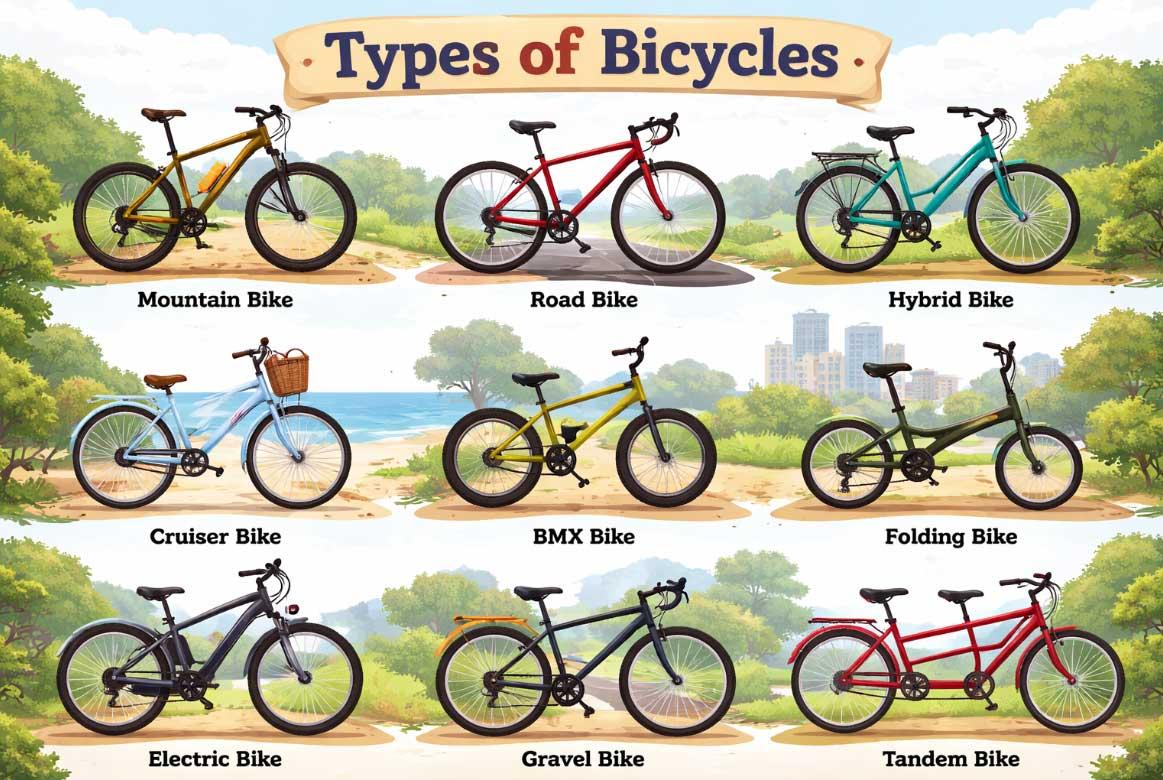
There are roughly two billion bicycles in the world. More than twice the number of cars. They exist in sheds and storefronts, in Amsterdam canal-side racks and Nairobi back alleys, on velodrome tracks and Himalayan switchbacks. Yet most people, when asked to describe a bicycle, conjure the same image — two wheels, a frame, handlebars, a seat. The platonic bike. The thing that exists before context.
That image is a lie of convenience.
The bicycle has evolved into dozens of distinct species, each shaped by terrain, purpose, culture, and the particular obsessions of the humans who ride them. Understanding the difference between a road bike and a gravel bike, or a city cruiser and a Dutch transport bike, isn't pedantry. It's the difference between enjoying your ride and dreading it.
This is the full taxonomy. Every major type, what it's for, what makes it tick, and who belongs on it.
Road Bikes — Speed as a Philosophy
Road bikes are the greyhounds of cycling. Everything about them is built around one principle: go faster. The frames are light — often carbon fibre, sometimes aluminium — and the geometry puts the rider in a forward-leaning aerodynamic crouch. Drop handlebars curve downward, giving multiple hand positions and reducing wind resistance. Tyres are narrow, typically 23mm to 28mm, inflated to high pressure to reduce rolling resistance on smooth tarmac.
Riding a road bike on a good surface feels like flying. The efficiency is startling — each pedal stroke translates almost entirely into forward momentum. For long-distance touring, sportive events, or just the pure pleasure of covering ground quickly on a weekend morning, nothing competes.
The trade-off is unforgiving. Road bikes hate potholes. They hate gravel. They hate anything their narrow tyres can't roll smoothly over. On rough urban streets, the vibration travels up through the frame and into your hands and back with merciless fidelity. They also require a reasonable baseline of fitness to ride comfortably — that aerodynamic position asks something of your core and flexibility.
Road bikes subdivide further: endurance road bikes soften the geometry slightly for longer comfort; aero road bikes take the speed obsession even further with integrated components and teardrop tube shapes; lightweight climbers are tuned for mountain passes. But all of them share the same DNA.
Best for: Fitness cycling, long-distance road riding, racing, sportives.
Mountain Bikes — Engineering for the Chaos of Dirt
If road bikes are about control and efficiency, mountain bikes are about survival and exhilaration. They were born in the 1970s in Marin County, California, where a group of cyclists started riding modified cruiser bikes down fire roads. What emerged from that experiment became one of the most technically sophisticated categories in cycling.
Modern mountain bikes come in three main formats based on suspension:
Hardtail: Front suspension fork only. Lighter, more efficient pedalling, cheaper. Excellent for cross-country riding and riders who spend time on smoother trails.
Full suspension (dual suspension): Both front fork and rear shock absorber. More complex, heavier, but dramatically more capable on technical terrain. The rear suspension can be tuned for different trail characteristics.
Rigid: No suspension at all. Used primarily in bikepacking, touring, or as a training tool. The rider's body does the absorbing.
The tyres are wide — typically 2.2 to 2.6 inches — with aggressive tread patterns that grip mud, rock, and loose dirt. The geometry is slack: a low bottom bracket and relaxed head tube angle keep the bike stable at speed on descents. Flat or riser handlebars give direct steering control.
Sub-disciplines within mountain biking are almost their own sports. Cross-country (XC) bikes prioritise climbing efficiency and light weight. Trail bikes balance climbing and descending. Enduro bikes are built for aggressive all-day riding. Downhill bikes — heavy, heavily suspended, not really designed to pedal uphill at all — are for bike park laps only.
Best for: Off-road trails, dirt paths, technical terrain, bike parks, bikepacking.
Gravel Bikes — The Category That Changed Everything
No bicycle type has grown faster in popularity over the last decade than the gravel bike. It arrived as a quiet solution to a specific problem — road cyclists who wanted to explore unpaved routes without buying a mountain bike — and ended up rewriting the rules about what a bicycle could be expected to do.
Gravel bikes look superficially like road bikes. They have drop handlebars and a similar frame profile. But the differences are substantial. The tyre clearance is much wider, typically accommodating tyres up to 45mm or even 50mm. The geometry is more relaxed — longer wheelbase, higher stack — which means a more upright, stable riding position. The gearing tends to be lower, suited to loaded riding on rough terrain.
The result is a bike that handles forest tracks, gravel paths, dirt roads, light mud, and tarmac with equal competence. It won't be the fastest on pure pavement, and it won't handle a black-run mountain bike trail. But for the vast middle ground — the kind of riding that most of the world's roads and paths actually offer — it's extraordinarily capable.
Gravel riding has spawned its own racing scene, with events like Unbound Gravel in Kansas drawing thousands of riders for 200-mile unsupported races across farm tracks. It's also become the bike of choice for adventure touring and bikepacking.
Best for: Mixed terrain, adventure riding, bikepacking, long-distance touring, riders who want one bike that does most things.
City and Hybrid Bikes — Pragmatism With Character
Not every cyclist wants to race or trail-blast. Most people who ride bikes use them to get somewhere — to work, to the market, to meet a friend. For these riders, the city bike and hybrid represent the honest, unglamorous backbone of urban cycling.
Hybrid bikes blend elements of road and mountain bikes. They sit upright, have flat handlebars for easy handling in traffic, medium-width tyres that handle road imperfections without drama, and gearing suitable for urban gradients. Most have mounts for racks and mudguards. They're not fast by road bike standards, but they're fast enough — and vastly more comfortable over city terrain.
City bikes (sometimes called urban bikes or commuter bikes) lean further toward practicality. Many come pre-fitted with lights, mudguards, chain guards, and integrated locks. Dutch-style city bikes — heavy, upright, built to last thirty years in all weather — have become iconic in cycling cities like Amsterdam and Copenhagen. They're not efficient. They weigh a lot. They ask nothing of you athletically. And they are, for their purpose, absolutely perfect.
Cargo bikes are a close relative worth mentioning: long-tail cargo bikes and front-loader (bakfiets) bikes have replaced cars for family transport in many European cities, carrying children, groceries, and delivery packages with calm efficiency.
Best for: Commuting, errands, casual urban riding, everyday transport.
Touring Bikes — Built for the Long Game
A touring bike is what you ride when your destination is months away. These are the machines of people who decide to cycle across continents — through Central Asia, down the Pan-American Highway, across Australia's emptiness. They are built, above all else, to not fail.
Touring bikes have steel frames, typically chromoly steel, which is strong, repairable, and has a slight flex that absorbs road vibration over long days in the saddle. They carry four pannier racks — front and rear — and their geometry keeps the load low and the handling predictable even under 30 kilograms of kit. The gearing spans an enormous range, from small climbing gears for Andean passes to larger gears for flat tailwind days.
They're not fast. They're not light. But they'll take you around the world and then let you do it again.
A related category is the bikepacking setup: a mountain or gravel bike fitted with frame bags, handlebar bags, and seat bags instead of racks. Bikepacking prioritises off-road capability and lower weight over carrying capacity.
Best for: Long-distance touring, multi-day rides, self-supported expeditions.
Track Bikes and Fixed-Gear Bicycles — Purity and Stubbornness
Track bikes exist at the philosophical extreme of simplicity. No gears. No freewheel. No brakes. The drivetrain connects the pedals directly to the rear wheel — if the wheel turns, the pedals turn. This is called a fixed-gear drivetrain, and it demands an entirely different relationship between rider and machine.
Track bikes are designed for velodromes — the steeply banked indoor or outdoor oval tracks where sprint and endurance track racing takes place. The fixed-gear drivetrain makes sense in that controlled environment: no coasting, total cadence control, no mechanical complexity to fail.
Fixed-gear bikes have also developed a devoted urban subculture. City riders adapted track bikes for street use, often adding a front brake for safety while keeping the rear brakeless (legal in some countries, not in others). The appeal is partly aesthetic — the clean lines of a brakeless track bike are genuinely beautiful — and partly philosophical. Riding fixed forces attention. You feel every nuance of the road.
Riding one in traffic without brakes is, to put it gently, a choice that requires confidence, quick reactions, and an optimistic view of human nature.
Best for: Velodrome racing, fitness riding, urban cycling (with appropriate brakes), those who find simplicity compelling.
BMX Bikes — Small, Loud, Relentless
BMX — Bicycle Motocross — began in the early 1970s when California kids started racing on dirt tracks, inspired by motocross racing. What emerged was a small, low, tough bicycle built for short bursts of speed, jumps, and tricks.
BMX bikes have 20-inch wheels (or 24-inch on the cruiser variant), single-speed drivetrains, and frames built to absorb impact. They exist in several disciplines: race BMX is about explosive speed on dirt tracks with berms and jumps; freestyle BMX — which became an Olympic sport in 2020 — is about tricks performed in skate parks, on street obstacles, or in flatland spaces.
Freestyle BMX bikes have gyro mechanisms that allow the handlebars to spin 360 degrees without tangling the brake cable. They have pegs on the axles for grinding. They're designed to be ridden in ways that would destroy ordinary bicycles.
BMX isn't just for children, despite the common assumption. The top freestyle and race BMX riders are world-class athletes. Park riding especially — launching off quarter-pipes and performing inverted aerials — requires extraordinary skill, strength, and nerve.
Best for: Dirt track racing, skate parks, tricks and freestyle, youth cycling.
Electric Bikes (e-Bikes) — The Argument Settler
The e-bike debate used to be heated. Cyclists argued about whether they were "real" cycling, whether they belonged on bike paths, whether they were cheating. That debate is mostly over now, settled by sheer volume: e-bikes outsell traditional bicycles in many European markets, and the category is growing faster than any other.
E-bikes use a battery-powered motor to assist the rider's pedalling. They don't replace effort — they amplify it. Most operate on a pedal-assist basis: the motor only engages when you pedal, and the assistance cuts out at a set speed (typically 25 km/h in Europe, 32 km/h in the US). The effect is that hills become manageable, headwinds disappear, and arriving at work without being drenched in sweat becomes possible.
Nearly every bicycle type now has an electric variant. E-road bikes. E-mountain bikes (which have transformed trail access for older and less fit riders). E-cargo bikes that carry entire families. E-gravel bikes. The motor adds weight — usually 2-4 kilograms — but for most practical purposes, the assistance more than compensates.
The technology is improving rapidly. Battery range, once a genuine concern, now extends to 100 kilometres or more on mid-range systems. Integration has become seamless — modern e-bikes often look nearly identical to their non-assisted equivalents.
Best for: Commuting, older riders, those returning to cycling, hilly terrain, heavy cargo carrying.
Comparison Table
| Bike Type | Terrain | Tyre Width | Suspension | Speed (1–5) | Comfort (1–5) | Versatility (1–5) | Best Use Case |
|---|---|---|---|---|---|---|---|
| Road | Smooth tarmac | 23–28mm | None | ★★★★★ | ★★☆☆☆ | ★★☆☆☆ | Racing, fitness, long road rides |
| Mountain (HT) | Off-road, trails | 2.2–2.4" | Front only | ★★★☆☆ | ★★★☆☆ | ★★★☆☆ | XC trails, dirt paths |
| Mountain (FS) | Technical terrain | 2.3–2.6" | Front + rear | ★★★☆☆ | ★★★★☆ | ★★★☆☆ | Enduro, downhill, bike parks |
| Gravel | Mixed, unpaved | 35–50mm | None | ★★★★☆ | ★★★★☆ | ★★★★★ | Adventure, bikepacking, mixed roads |
| Hybrid / City | Urban roads | 35–42mm | None/optional | ★★★☆☆ | ★★★★☆ | ★★★★☆ | Commuting, daily errands |
| Touring | Roads + tracks | 35–45mm | None | ★★★☆☆ | ★★★★☆ | ★★★★☆ | Long-distance loaded riding |
| Track / Fixed | Velodrome, city | 23–25mm | None | ★★★★★ | ★★☆☆☆ | ★☆☆☆☆ | Racing, urban fixed riding |
| BMX | Dirt, skate parks | 2.0–2.3" | None | ★★☆☆☆ | ★★☆☆☆ | ★★☆☆☆ | Tricks, racing, skate parks |
| e-Bike | Varies by type | Varies | Varies | ★★★★☆ | ★★★★★ | ★★★★★ | Commuting, hills, cargo, accessibility |
Choosing the Right Bike: What Actually Matters
The bicycle industry has a talent for making this feel overwhelming. Catalogs run to hundreds of pages. Forums debate component specifications in religious terms. Marketing makes each new model sound like a categorical revolution.
Cut through it with three questions.
Where will you actually ride? Not where you'd like to ride, not in theory — where will you actually go? If the answer is city streets, you don't need a mountain bike. If the answer is forest trails at weekends, a road bike will make you miserable.
What do you want from riding? Speed and performance demand road or track bikes. Exploration and adventure point toward gravel or touring. Getting to work comfortably means hybrid or e-bike. Fun and tricks mean BMX or mountain. None of these is more legitimate than the others.
What's your budget and commitment level? Entry-level versions of every category exist and are perfectly viable. The expensive versions are faster, lighter, and more refined — but the diminishing returns are steep. A £600 gravel bike will take you everywhere a £6,000 gravel bike will, just slightly less efficiently and with marginally more noise from the drivetrain.
There is also no law against owning more than one. Many cyclists have a road bike for fitness, a mountain bike for weekends, and a cheap hybrid for commuting. The bikes are different tools for different jobs, the same way a kitchen contains more than one knife.
The Bike That Doesn't Exist Yet
Every category described here was, at some point, invented. The mountain bike didn't exist before the 1970s. Gravel bikes barely existed a decade ago. E-bikes were expensive curiosities fifteen years back and are now a mass market category.
The boundaries between types continue to blur. Gravel bikes are getting wider tyres and becoming lighter mountain bikes. E-MTBs are enabling trail access for demographics that never had it. Cargo bikes are replacing family cars at a rate that would have seemed extraordinary even five years ago.
The fixed truth is this: the bicycle remains one of the most efficient machines humans have ever created — more efficient, in terms of energy expended per kilometre covered, than any other form of transport. That core fact has not changed since the penny-farthing gave way to the safety bicycle in the 1880s.
What has changed is the variety. The breadth of the answer to the question: what kind of bicycle?
The answer, it turns out, is: nearly any kind you need.
Whether you're a veteran cyclist evaluating your next purchase or someone standing in a bike shop for the first time, the taxonomy above gives you a map. Use it as a starting point, not a cage. The best bike is always, in the end, the one that makes you want to ride.