The Road Starts Here
Nobody is born knowing how to ride a bike. Not the lycra-clad cyclists you see slicing through morning traffic at dawn, not the casual commuters balancing coffee cups on their handlebars, and certainly not the competitive racers who make climbing a steep hill look like a mild inconvenience. Every single one of them started at the same place you're standing now — next to a bike, slightly unsure, wondering how two thin wheels and a metal frame are supposed to carry them anywhere with any dignity.
The good news? Cycling is one of those rare physical skills that, once learned, stays with you for life. The bad news? Most beginners are taught poorly. They're told to "just pedal" and then left to figure out the rest, which usually means developing bad habits that take years to unlearn. This guide exists to close that gap. It covers not just the mechanics, but the why behind each technique — because understanding what you're doing makes you a far better cyclist than blindly following instructions.
Let's start from the very beginning.
Before You Ever Touch the Pedals — Bike Fit Is Everything
The single most overlooked aspect of beginner cycling is also the most important: your bike needs to fit your body before you can ride it well. A poorly fitted bike doesn't just cause discomfort — it creates inefficiency in every pedal stroke, increases your injury risk, and makes every ride harder than it needs to be.
Saddle Height
Your saddle height determines the quality of your pedal stroke. Too low, and you'll be pushing in short, choppy circles with your knees doing all the heavy lifting. Too high, and your hips will rock side to side, wasting energy and stressing your lower back.
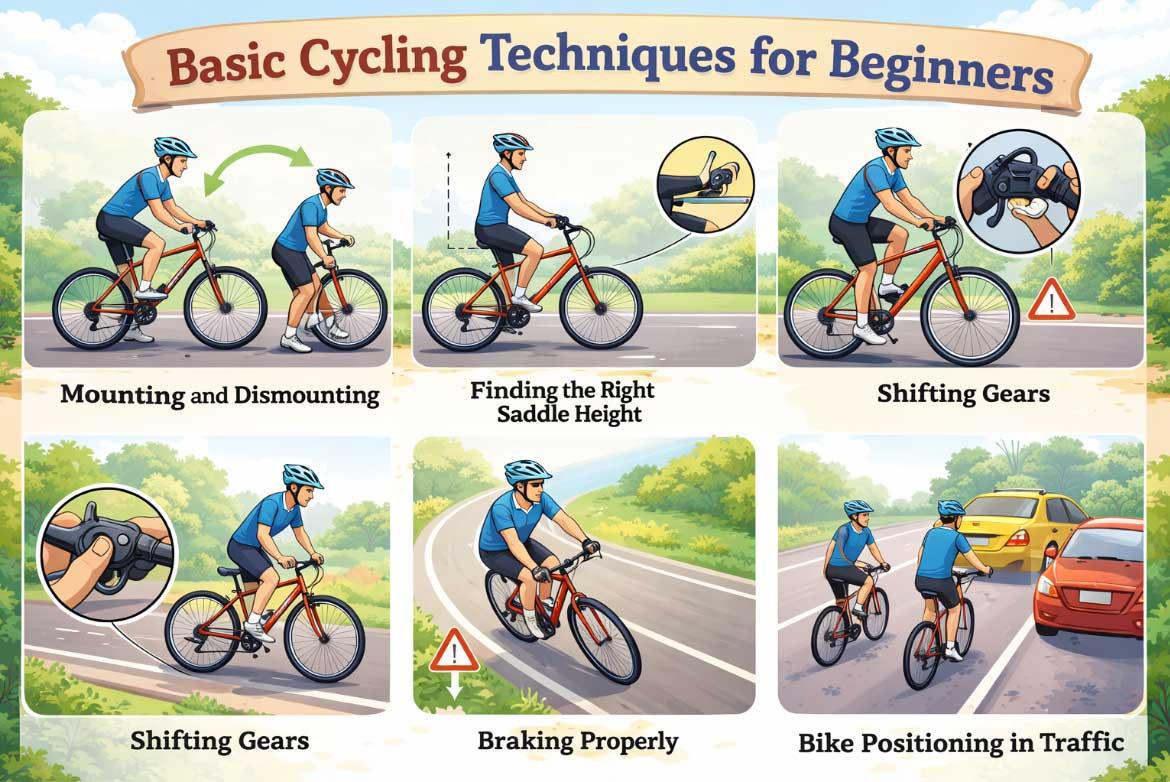
The classic method for finding your saddle height: sit on the bike with your heel placed on the pedal. When the pedal is at its lowest point (6 o'clock position), your leg should be fully straight. When you shift to riding normally with the ball of your foot on the pedal, your knee will have a slight, healthy bend — roughly 25 to 35 degrees. This is your power zone. This is where efficiency lives.
Handlebar Position
Handlebars that are too low force you into an aggressive forward lean that strains your neck, shoulders, and wrists. For beginners, slightly raised handlebars (roughly level with your saddle or a touch higher) encourage a more upright, comfortable position that's easier to maintain for longer rides. As your core strength and flexibility develop, you can experiment with lower positions.
Reach
When you hold the handlebars with a relaxed grip and your elbows are slightly bent, your back should form roughly a 45-degree angle to the ground — not hunched over the bike like you're trying to fit through a small doorway, and not sitting completely upright like you're at a dining table. A natural, comfortable reach lets your arms absorb road vibrations rather than transmitting every bump directly to your spine.
Mounting and Dismounting — The Unsung Art
This sounds trivially simple. It is not. Watch any group of beginners and you'll immediately spot who hasn't been taught proper mounting technique — they're the ones hopping awkwardly from a dead standstill, wobbling dangerously as they try to get their feet positioned.
To mount properly: Stand on the left side of your bike. Squeeze the brakes to hold the bike still. Swing your right leg over the saddle. Place one foot on the pedal at roughly the 2 o'clock position — this is your power position for the initial push-off. Push down on that pedal firmly, let the bike start moving, and bring your other foot onto the second pedal as you settle onto the saddle. It should feel like one fluid motion, not a desperate scramble.
To dismount: Slow to near-stop using your brakes. Shift your weight slightly forward off the saddle. Swing one leg back over the bike while keeping one foot on the ground to catch yourself. Squeeze the brakes fully to prevent the bike rolling away.
Practice this until it feels automatic. You'll thank yourself at traffic lights.
The Pedal Stroke — Where Power Actually Comes From
Here's something most beginner guides skip entirely: not all pedal strokes are created equal. The difference between a beginner's pedal stroke and an experienced cyclist's is enormous, and it has everything to do with how they apply force through the full rotation.
The Dead Zones
A basic, untrained pedal stroke applies power only on the downstroke — from roughly 12 o'clock to 6 o'clock. But the pedal continues rotating through 6 o'clock back up to 12, and most beginners let that upper half of the rotation go completely to waste. Worse, an untrained leg on the upstroke can actually resist the pedalling leg, actively making it work harder.
Learning the Full Circle
Think of your pedal stroke as four distinct phases:
The Power Phase (12 to 6 o'clock): This is where most of your force goes. Push forward and down, like you're scraping mud off the bottom of your shoe at the bottom of the stroke. Don't just stomp — drive through the entire arc.
The Backstroke Phase (6 to 9 o'clock): As your foot passes through the bottom, think about dragging it backward along the bottom of the circle. This engages your hamstrings and prevents your opposing leg from fighting the rotation.
The Dead Zone (9 to 12 o'clock): The upstroke is hardest to activate without clipless pedals, but even with flat pedals, consciously lifting your knee through this phase reduces the resistance your pedalling leg has to overcome.
The Forward Push (12 o'clock): As your foot comes over the top, push it slightly forward before beginning the power phase again.
You won't perfect this immediately — it takes weeks of conscious practice. But even partial improvement in your pedal stroke efficiency has a dramatic effect on how far and fast you can ride.
Gears Explained — The Thing Nobody Teaches Properly
Gears might be the most misunderstood element of cycling for beginners. Many new cyclists either ignore them entirely (riding in one gear for everything) or change them randomly without understanding the logic. Neither approach serves you well.
The Core Principle — Cadence
Cadence is the number of times your pedals complete a full revolution per minute (RPM). Experienced cyclists maintain a cadence of roughly 80 to 100 RPM regardless of terrain. Why? Because spinning a lighter gear quickly is far more efficient for your cardiovascular system and far kinder on your joints than grinding a heavy gear slowly.
When you're riding in too high a gear (too hard to push), your cadence drops, your legs fatigue quickly, and your knees take significant strain. When you're in too low a gear (spinning too easily), you lose power and speed without getting the cardio benefit. The goal is to find the gear that lets you maintain that sweet-spot cadence.
When to Shift
Shift before you need to, not after. Trying to shift gears while you're already under heavy load — climbing a steep hill, for instance — risks damaging your drivetrain and causes clunky, inefficient shifts. When you see a hill approaching, drop to a lower gear early, while you're still on flat ground. When you're descending or on flat road with speed, shift up progressively.
Front vs. rear gears: If your bike has two chainrings at the front (a double) and a cassette at the rear, the front gears make large jumps in difficulty and should be changed relatively infrequently. The rear cassette gives you fine-tuning within those ranges. Use your rear gears constantly; use your front gears for significant terrain changes.
Braking — The Skill That Could Save Your Life
Most beginner cyclists either don't brake enough (terrifying) or grab both brakes hard in a panic (almost as terrifying). Proper braking is a genuine technique that takes practice.
Front vs. Rear Brake
Your front brake provides the majority of your stopping power — physics dictates that when you brake, weight shifts forward, giving the front wheel more grip. The rear brake provides stability and control. The common fear among beginners is that heavy front braking will send you over the handlebars. In practice, this only happens at very high speeds or on extremely steep descents when excessive force is applied. At normal riding speeds, the front brake is your primary tool.
The technique: Apply both brakes simultaneously and progressively. Squeeze gradually rather than grabbing suddenly. Keep your weight back on the saddle when braking hard — this prevents the weight transfer from becoming dangerous. Give yourself more stopping distance than you think you need. Wet conditions can increase stopping distance by 50 percent or more.
Feathering
Feathering means applying light, gentle brake pressure — enough to slightly slow you without fully committing to a hard stop. This is invaluable on long descents, in traffic, and when navigating tight corners where you want to control speed without upsetting your balance or traction.
Steering and Cornering — More Than Just Turning the Handlebars
Beginners tend to steer by moving the handlebars. Experienced cyclists steer primarily by shifting their weight and leaning the bike. The difference matters enormously at any speed above a casual crawl.
Countersteering
At cycling speeds, you initiate a turn by briefly pushing forward on the handlebar in the direction you want to turn — which causes the bike to lean in that direction — and then leaning into the corner. This feels counterintuitive until you've felt it a few times, at which point it becomes completely automatic. Don't try to consciously think through this; practice it on a quiet road and let your body learn the sensation.
Looking Through the Corner
Where your eyes go, your body follows. When approaching a corner, look not at the corner itself but at where you want to exit the corner. Fix your gaze on that exit point early and your body will naturally guide the bike toward it. Looking down or at obstacles in your path is a reliable way to ride directly into them.
Pedal Position in Corners
When cornering, put the outside pedal down (at the 6 o'clock position) and press your weight into it. This lowers your centre of gravity, increases your tyre's contact patch with the road, and prevents your inside pedal from scraping the ground on sharper turns. This is a habit worth building immediately.
Riding in Traffic — Confidence and Visibility
For most urban beginners, this is the source of the most anxiety. Traffic is genuinely intimidating, and that anxiety is reasonable. But nervous, erratic riding is actually more dangerous than confident, assertive riding.
Take your lane when appropriate. Riding too close to the kerb forces cars to try to squeeze past you in the same lane — which is dangerous. Riding a metre or so from the kerb gives you room to manoeuvre around drain covers and surface debris, and signals to drivers that they need to change lanes to overtake you safely.
Be predictable. Signal your turns. Maintain a straight line rather than weaving. Don't dart between parked cars. Drivers can accommodate cyclists who behave predictably; they cannot accommodate cyclists who make sudden, unexpected movements.
Eye contact. At junctions, try to make eye contact with drivers before proceeding. A nod of acknowledgement from a driver tells you they've seen you. Don't assume visibility; confirm it.
Climbing and Descending — The Great Dividers
Hills reveal everything about a cyclist's technique. Watch a beginner and an experienced cyclist approach the same climb and you're watching two entirely different sports.
Climbing
Shift to an appropriate gear before you hit the slope. Keep your cadence smooth rather than grinding. Grip the handlebars lightly — death-gripping the bars while climbing wastes energy and creates tension throughout your upper body. Keep your upper body relaxed. Breathe rhythmically. If you need to stand on the pedals, shift up one gear first (standing provides more leverage, so you can handle a heavier gear), move your weight slightly forward, and keep the bike fairly upright beneath you.
Mentally, break long climbs into sections. Commit to reaching a lamp post, a tree, a junction — not the top. The top takes care of itself.
Descending
Speed on descents makes beginners nervous, and that's correct instinct — more speed means less margin for error. But tense, panicked descending is actually more dangerous than relaxed, controlled descending.
Feather your brakes on the way down rather than applying them in sudden bursts. Keep your weight back. Look further ahead than you normally would — at higher speeds, hazards arrive faster and you need more time to respond. Keep your knees slightly bent and your pedals level (3 and 9 o'clock) to act as natural shock absorbers.
Beginner Mistakes vs. Correct Techniques
| Situation | Common Beginner Mistake | Correct Technique | Why It Matters |
|---|---|---|---|
| Saddle height | Too low; knees over-bent | Slight bend at full extension (~30°) | Prevents knee injury; improves power output |
| Pedal stroke | Stomping only on downstroke | Full circular stroke with back-drag | Improves efficiency; reduces fatigue |
| Braking | Grabbing rear brake only | Gradual pressure on both brakes simultaneously | Shorter stopping distance; better control |
| Gears | Riding in one gear or shifting too late | Shift early; maintain 80–100 RPM cadence | Protects joints; sustains energy longer |
| Cornering | Steering with handlebars only | Lean and weight-shift; outside pedal down | Better grip; smoother, safer turns |
| Climbing | Grinding a heavy gear slowly | Lower gear, higher cadence, relaxed grip | Conserves energy; protects the knees |
| Descending | Hard braking mid-corner | Feathered braking before corners; weight back | Maintains traction; prevents skidding |
| Traffic positioning | Hugging the kerb | Riding one metre from kerb | Prevents being squeezed; improves visibility |
| Mounting | Hopping from standstill | Pedal at 2 o'clock, push off cleanly | Stable start; immediate control |
| Looking | Eyes down at the road | Eyes up, scanning ahead | Earlier hazard detection; natural steering |
Building Mileage — The Patience Problem
Every beginner wants to ride further and faster than their body is currently ready for. This is understandable and also the primary reason most beginners either injure themselves or burn out in the first month.
The established rule among coaches: increase your weekly mileage by no more than 10 percent per week. It sounds conservative. It is conservative. It also works. Your cardiovascular system adapts to cycling relatively quickly — your tendons, ligaments, and connective tissue adapt far more slowly. Outpace your connective tissue's recovery and you'll be dealing with knee pain, saddle sores, and tendonitis before you've built any real fitness.
Start with three short rides per week. Twenty to thirty minutes each. Focus entirely on technique — smooth pedalling, appropriate gears, clean braking — rather than distance or speed. After two weeks, add ten minutes to one of your rides. After four weeks, add another ride. The mileage will come. The technique, if you build it now, will last a lifetime.
The Mental Side of Cycling
Nobody mentions this in beginner guides, but it deserves space here. Cycling has a significant psychological dimension, especially in the early stages. Hills that look small feel enormous. Traffic that seems manageable from a car feels confrontational on a bike. Wind that barely registers when you're walking becomes a relentless opponent when you're trying to maintain forward momentum.
The mental pattern that serves beginners best is a simple one: separate each challenge. Don't think about the hill coming up at the end of a ride while you're still warming up. Don't think about traffic while you're still on a quiet road. Focus on what's in front of you right now, execute the technique you've been practicing, and let the rest resolve itself.
There's also something worth saying about bad rides. They happen to everyone. Some days the legs feel like they're filled with concrete. Some days the wind is in your face for the entire route, both ways, somehow. Some days everything just feels harder than it should. Bad rides are not signs that you're failing or that cycling isn't for you. They're just days. Show up again tomorrow.
Your First Real Ride Checklist
Before heading out for your first proper ride, run through this:
Bike: Tyres inflated to recommended PSI (printed on the tyre sidewall). Brakes checked — squeeze each brake and rock the bike forward; it shouldn't move. Chain lubricated. Saddle at correct height.
Yourself: Helmet fitted properly (sits level, two fingers above eyebrows, chin strap snug). Appropriate footwear — no loose laces, no sandals. Water bottle. If riding in low light, front and rear lights fitted and switched on.
Route: Choose a quiet route for your first few rides. Parks, residential streets, dedicated cycling paths. Save main roads and complex junctions for when you're comfortable with your basic technique.
The Long Game
Cycling rewards patience and consistency more than almost any other sport. The techniques covered here — proper saddle height, efficient pedal stroke, smart gear use, progressive braking, clean cornering — don't take months to begin improving. They take focused attention over a handful of rides.
But here's the honest truth about cycling as a beginner: you won't nail all of this at once. You'll forget to shift gears on a hill. You'll brake too hard at a junction. You'll take a corner too wide. All of this is fine. All of it is normal. The goal at the beginning is not perfection — it's progressive, deliberate improvement over time.
Cycling is one of the few sports where you genuinely can get better every single week for years. The ceiling is high, the learning curve is manageable, and the reward — the particular freedom of moving through the world under your own power, at speed, in the open air — is unlike almost anything else.
You already have everything you need. The only thing left is to ride.
Happy cycling. The road gets easier the more time you spend on it.