What Is a Fat Tire Bike, and Why Does It Matter?
Before getting into the Malus specifically, it helps to understand why fat tire bikes exist at all. Fat tire bikes are a category defined by their extra-wide rims, wider forks, and dramatically wider tires than those found on traditional bicycles — most falling between 2.5 and 5 inches in width, with inflation pressures running from just 7 to 30 psi. That low pressure is the secret weapon. Run a fat tire soft enough and it conforms to the terrain beneath it, creating a contact patch that provides grip and float on surfaces where conventional tires would sink, slide, or simply bounce you off.
The concept came out of a genuine problem: riders who loved mountain biking had nowhere to go in winter. In 2005, mountain bikers and their manufacturers began seriously working to solve the problem of riding in cold winter months when traditional tires simply weren't appropriate. The result was the fat bike — and it turned out that the solution for snow worked brilliantly on sand, mud, gravel, and loose dirt too. A niche experiment became a category.
The Mongoose Malus sits squarely in that tradition, priced to bring it within reach of riders who've been curious but didn't want to spend four figures to find out if fat biking is their thing.
The Frame: Built to Last, Not to Be Light
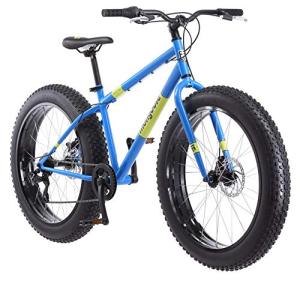
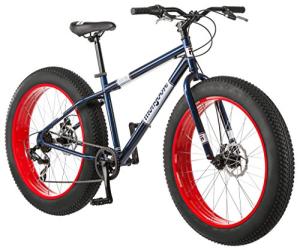
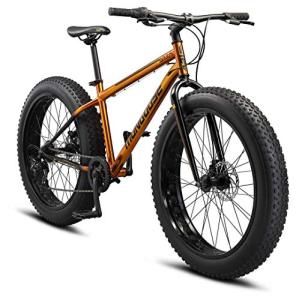
The Malus rides on a steel mountain-style fat tire frame with 26-inch wheels, sized to fit riders from 5'4" to 6'2" tall. The steel construction is a deliberate choice that divides opinion, but for the right rider it's exactly what's needed. Steel absorbs trail vibration better than aluminum, it welds cleanly, it can be repaired by any competent mechanic, and it doesn't fail catastrophically when stressed — it bends first, giving you warning. For a bike that's going to be thrown at rocky shorelines and rutted trails, that matters.
The Malus uses an 18-inch frame with a cruiser-style geometry rather than a traditional mountain bike geometry. This is a meaningful distinction. The cruiser frame offers more clearance, making it a comfortable choice for casual riding and genuinely suitable for both men and women — unlike the Mongoose Dolomite, which is built more specifically around men's geometry. The upright riding position this creates is less aggressive but more relaxed, which translates to longer rides with less fatigue in the back and shoulders.
The trade-off, as with most steel fat bikes, is weight. Fat bikes are heavy as a category, and the Malus comes in at approximately 45 pounds fully assembled. That's not a lightweight machine by any measure, and you'll feel it on long climbs. But it also means the bike feels planted and stable at speed — there's a solidity to it that flimsy bikes can't replicate.
The Tires: 4 Inches of Pure Confidence
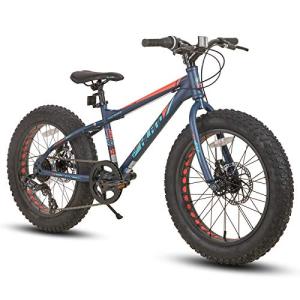
If the frame is the Malus's body, the tires are its personality. The 4-inch-wide knobby fat tires deliver massive grip, giving you control even on loose sand, deep snow, and sketchy trails where others might slip up. These aren't decorative — they genuinely change what's rideable.
On sand, where narrow tires dig in and stall, the Malus floats. On snow, where road bikes become skating hazards, the fat knobs find purchase and keep rolling. On mud, where most mountain bikes require careful picking of lines, the Malus allows a more committed, direct approach. The knobby 4-inch wide tires roll over anything in their path, and the 4-inch alloy rims are designed to be both light and strong.
The rims themselves are drilled alloy — not as heavy as solid steel alternatives, and with enough structural integrity to handle the lateral forces that come from aggressive cornering on loose terrain. Run the tires at lower pressure for maximum float on soft surfaces, or pump them up a bit for faster rolling on packed dirt. The Malus is genuinely tunable to conditions in a way many bikes simply aren't.
The Drivetrain: Seven Speeds, Zero Fuss
The Malus is equipped with 7-speed twist shifters and a Shimano rear derailleur for quick and precise gear changes across various terrains. Seven speeds might sound modest in an era when road bikes are running 12-speed electronic groupsets, but for the use case this bike serves, it's the right call.
Seamless gear transitions with the 7-speed shifter ensure smooth and effortless changes for a more enjoyable riding experience. The twist shifter design is intuitive enough for new riders to use without thinking, and durable enough to handle the abuse that trail riding demands. Shimano's rear derailleur brings a brand-name reliability to the shifting that cheaper no-name alternatives can't match — it indexes precisely, returns to position predictably, and is easily adjusted in the field with a barrel adjuster.
The range of gears covers both the grunt work of slow technical climbing and the higher cadence of flat coastal trails. You won't be spinning out on descents, and you'll find a gear low enough to grind up most hills without dismounting.
The Brakes: Stopping Power That Matches the Terrain
The Malus includes front and rear disc brakes, providing secure stopping power for enhanced control and safety. On a 45-pound fat bike carrying a rider, that braking performance is not optional — it's essential. Disc brakes work by clamping a rotor mounted to the wheel hub rather than squeezing the rim, which means their performance doesn't degrade in wet conditions the way rim brakes do.
The front and rear disc brakes ensure crisp stopping and precise speed control, adding an extra layer of safety to your rides. Whether you're descending a loose gravel track or navigating wet roots near a riverbank, the brakes respond immediately and modulate predictably. They require occasional adjustment as cables stretch with use, but this is a simple five-minute job with a screwdriver.
The Cockpit: Control Where It Counts
The alloy A-head stem and mountain handlebar keep you in complete control out on the trail. The handlebar is wider than what you'd find on a road or hybrid bike — this isn't incidental. A wider bar gives more leverage for steering on technical terrain, makes the bike easier to maneuver at low speeds, and puts the rider in a more naturally supported position for uphill efforts.
The Malus comes with a cruiser seat, which is more comfortable than the traditional MTB saddle found on the Dolomite. For riders who aren't wearing cycling-specific shorts and don't want to, this matters. The broader saddle distributes weight more generously and makes longer, more casual rides genuinely comfortable.
Who Is the Malus For?
In reality, what many owners have found is a solid basis for a fun upgrade project — and for many, the low price is well worth it just for the solid frame and tires. But taken as it comes out of the box, the Malus is an excellent choice for a specific kind of rider.
It suits the adventure-curious rider who wants to explore beaches, forest paths, and winter trails without committing to a premium fat bike investment. It works for commuters who need something that won't be stopped by poor road conditions. It's well-matched for the casual weekend rider who wants a machine that handles variety without requiring a technical background to operate. And thanks to its unisex geometry, it serves both men and women equally well.
Whether you're navigating rough terrain or cruising along the beach, the Mongoose Malus delivers a smooth and controlled ride. That versatility is its core promise — and it largely delivers on it.
Comparison Table: Mongoose Malus vs. Key Competitors
| Feature | Mongoose Malus | Mongoose Dolomite | Outroad Fat Tire MTB |
|---|---|---|---|
| Frame Material | Hi-Ten Steel | Hi-Ten Steel | Carbon Steel |
| Frame Size | 18" (Cruiser Style) | 17" (Traditional MTB) | One Size |
| Wheel Size | 26" | 26" | 26" |
| Tire Width | 4 inches | 4 inches | 4 inches |
| Speeds | 7 | 7 | 21 |
| Rear Derailleur | Shimano | Shimano | Generic |
| Brakes | Mechanical Disc | Mechanical Disc | Mechanical Disc |
| Weight | ~42 lbs | ~48–50 lbs | ~44 lbs |
| Rider Height | 5'4"–6'2" | 5'4"–6'2" | 5'2"–6'2" |
| Weight Capacity | ~300 lbs | ~350 lbs | ~330 lbs |
| Gender | Unisex | Men's Geometry | Unisex |
| Terrain | All-terrain | All-terrain | All-terrain |
| Colors Available | 4 | 3 | 2 |
The Malus is the newer generation of fat tire bikes from Mongoose compared to the Dolomite, and the brand's improvements in weight and rider comfort are evident. While the Dolomite edges ahead in maximum weight capacity, the Malus wins on maneuverability and comfort thanks to its lighter weight and cruiser frame geometry. Against the Outroad, the Malus's Shimano drivetrain component and established brand support give it an edge in long-term reliability, even if the Outroad's 21-speed system offers more gearing range.
In Short
The Mongoose Malus Silver/Yellow is not trying to be a race bike. It's not engineered for Strava KOMs or technical enduro lines. What it is, without apology, is one of the most capable and genuinely enjoyable entry-level fat bikes on the market — a machine that makes riding in conditions most bikes can't handle feel easy and, more importantly, fun.
There is nothing you can't do on a Mongoose and almost nowhere you can't go on the Malus. That's a bold claim. But when you're looking at a bike that handles sand, snow, dirt, gravel, and mud with equal composure, it's not a particularly difficult one to back up.
If you've been waiting for a reason to get outside in all seasons, the Malus is a compelling argument to stop waiting.
View the Mongoose Malus on Amazon →